Thirteen specific activities, each assigned to named street corners and plazas, each with its legal basis linked and its risk stated. Downtown Raleigh, Fayetteville Street, Labor Day weekend 2026.
Read this firstThis is legal research and information. It is not legal advice and creates no attorney–client relationship. Several factual points below are flagged as unverified and must be confirmed before the event. Consult a North Carolina attorney before acting.
01
The event
A free, ungated, family-oriented street festival in its seventeenth year, produced by a private nonprofit under a City of Raleigh special event permit that closes several blocks of Fayetteville Street.
Particulars
Item
Detail
Name
African American Cultural Festival of Raleigh & Wake County (17th annual) — aacfestival.org
Dates and hours
Saturday, Sept. 5, 2026, 11:00 a.m.–10:00 p.m. (art and vendor booths close at dusk; Family Village 11:00–7:00). Sunday, Sept. 6, 1:00–10:00 p.m. (Family Village and Creativation Station 1:00–7:00). Festival FAQ
Venue
Fayetteville Street block party, from Hargett Street south to City Plaza. Ticketed kickoff concerts are held separately at the Martin Marietta Center for the Performing Arts. Visit Raleigh listing
Organizer
A private 501(c)(3) nonprofit. Office at 5 W. Hargett Street, Room 702, Raleigh. [email protected]
City involvement
Every festival page states the program is funded in part by the City of Raleigh on the recommendation of the Raleigh Arts Commission. The festival is one of 35 Raleigh Arts Partners for 2025–2026, from a grant pool of $1,864,297.
Attendance
Roughly 50,000–60,000. Reporting cites Raleigh Police estimates approaching 60,000, up from about 15,000 in the first year.
Programming
Vendor Marketplace; African Marketplace; Art Gallery Walk; food vendors; Family Village with the Creativation Station; chalk “Art Walls where attendees can use colorful chalk to express themselves”; Main Stage; Village Stage.
Sunday worship
A live “Church Without Walls” service Sunday morning near the Village Stage. See sheet M.
Why the city funding matters
A private organizer that takes a city arts grant, holds a city permit, closes city streets, and coordinates with city police is entangled with government in ways that matter. It probably still controls its own stage and its own art installations — that is the organizer’s speech. But when it asks police to remove someone from a public street because of a message, that removal is government action, and the First Amendment applies to it directly.
02
The ground
Everything in this guide depends on knowing which patch of concrete you are standing on. Three regimes overlap within two blocks of each other.
The footprint
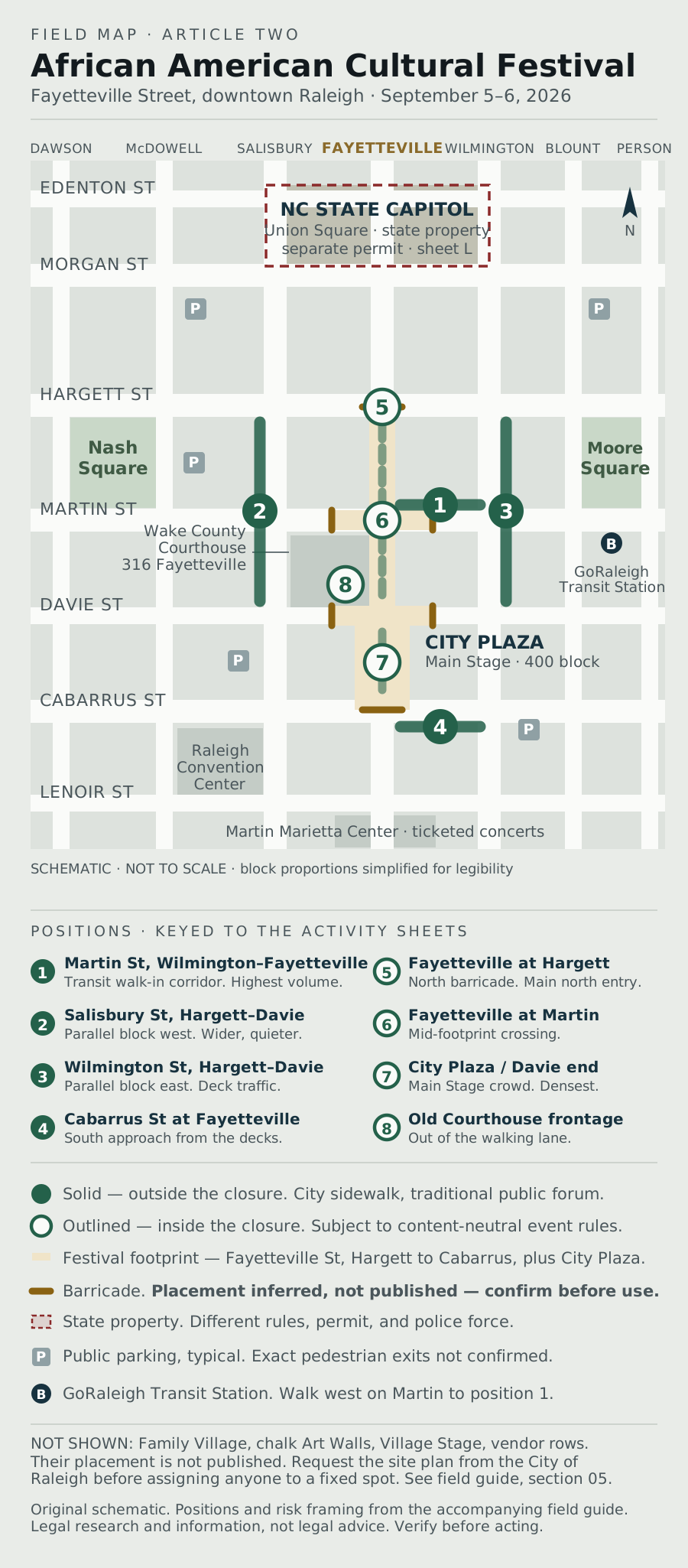
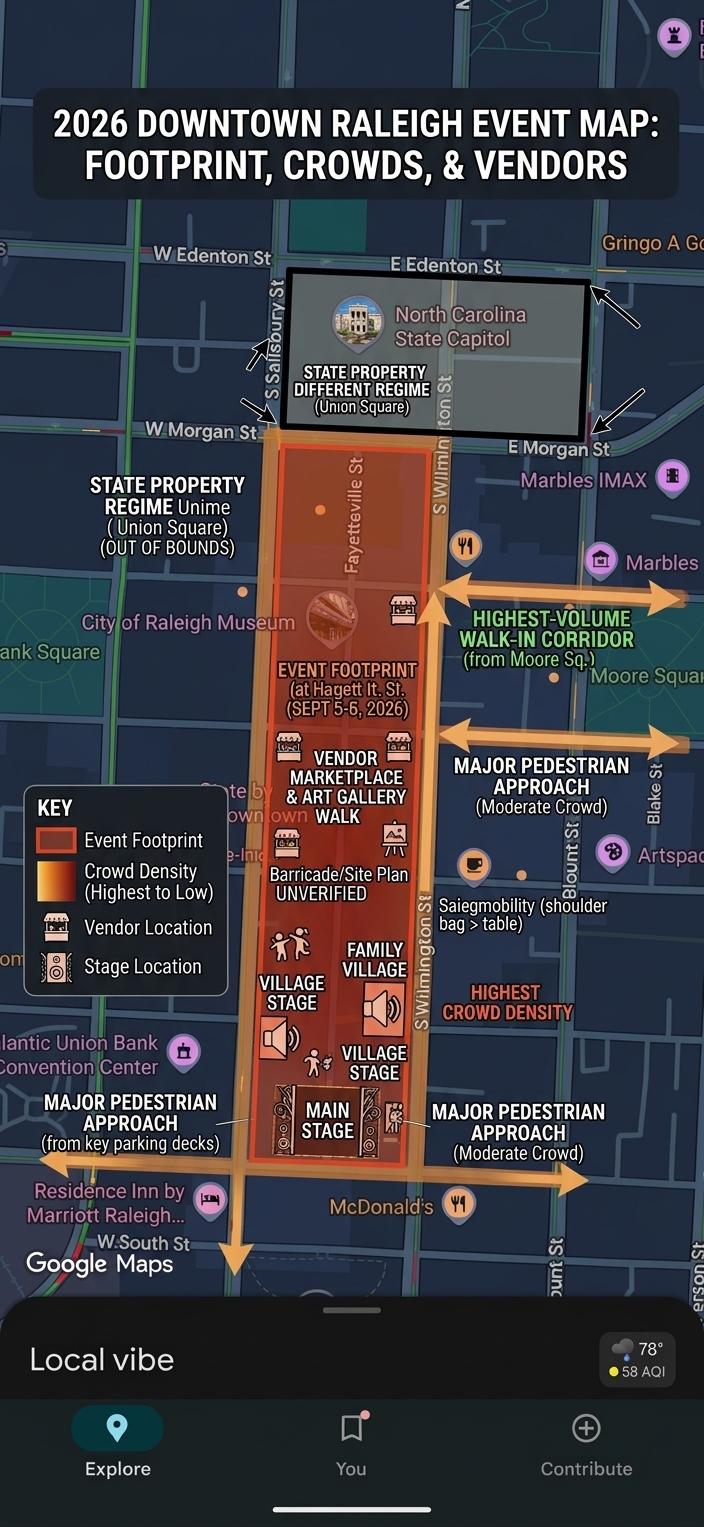
Fayetteville Street runs north to south through downtown. Its cross streets, in order, are Morgan → Hargett → Martin → Davie → Cabarrus → Lenoir. The NC State Capitol sits at the head of the street, north of Morgan. The festival occupies the stretch from Hargett south to City Plaza, with the Main Stage on City Plaza at the south end.
Flagged inference. The precise barricade pattern is drawn by analogy to Artsplosure, the other major Fayetteville Street festival run through the same city process, which closes the side streets — Davie, Martin, Hargett — between Morgan Street and City Plaza along with Fayetteville itself. That is the working assumption here. Confirm it against the actual 2026 traffic-control plan before assigning anyone to a specific corner. Section 06 explains how to obtain it.
Raleigh ordinances only. No permit, no organizer, no argument. Your strongest ground.
Fayetteville Street inside the closure
City of Raleigh, under permit to the organizer
Traditional public forum, subject to content-neutral event management
Raleigh ordinances plus reasonable, content-neutral crowd rules. Not organizer censorship.
Rented booth space
Organizer’s contractual space
Contract, not forum
The vendor agreement. You are bound by whatever you signed.
Union Square / NC State Capitol grounds, north of Morgan
State of North Carolina
Separate regime entirely
NC Dept. of Administration permit, State Capitol Police. City rules do not apply. See sheet L.
Verify the property line before you rely on it
The sidewalks immediately around Union Square — the Capitol block’s Morgan, Edenton, Wilmington, and Salisbury faces — are the likeliest state-owned segments. Most other downtown sidewalks are city-owned. The line is not marked on the pavement.
Check each corner you intend to use against Wake County iMaps before the day. Getting this wrong means applying the wrong rulebook to the wrong police force.
Where the people actually walk
The festival’s own guidance: city-owned lots and decks are open all weekend, metered street parking around Fayetteville Street is free on weekends, and state government visitor lots are typically free on weekends. Every attendee makes the walk from a deck or a bus twice.
From Moore Square Station and the Moore Square Deck The GoRaleigh downtown hub sits two blocks east. Riders exit and walk west on Martin Street to reach Fayetteville. This is the single highest-volume pedestrian corridor into the event, and it is ordinary open city sidewalk.
From the Wilmington Street Deck One block east; walkers reach the footprint via Martin or Davie.
From the Cabarrus Deck and the south lots Walkers come north up Fayetteville into the City Plaza end, past the Main Stage.
From the Convention Center and Charter Square decks On South Salisbury; walkers cut east on Davie or Cabarrus one block.
From the state government visitor lots North of the Capitol; walkers come south down Fayetteville past Union Square and enter at the Hargett end. Note this route crosses state property — see sheet L.
The free R-Line downtown circulator is still referenced on the festival site, but GoRaleigh has altered or suspended it in the past. unverified for 2026 Do not build a plan around a stop that may not exist.
03
Activity sheets
Each sheet covers one activity: where exactly to do it, how, what law supports or limits it, what the realistic exposure is, and what would change that. They are ordered from least exposed to most.
The sheets state risk; they do not tell you what to do with it. A tier marked “high exposure” is a description of what could happen, not a verdict on whether the activity is worth it. Some of what follows carries real cost and is worth bearing anyway; that calculation belongs to the people bearing it, not to a document. Where a sheet cannot quantify the exposure, it says so rather than guessing in either direction.
ProtectedCautionHigh exposure
Activity A
Tract distribution on the approach sidewalks
Protected
Where exactly
Martin Street between Wilmington and Fayetteville The Moore Square Station walk-in corridor. Highest volume, cleanest legal ground.
Salisbury Street sidewalk, Hargett to Davie One block west, parallel to the footprint.
Wilmington Street sidewalk, Hargett to Davie One block east.
Cabarrus Street at Fayetteville The south approach from the decks.
Deck pedestrian exits Where walkers emerge, before they reach the barricade.
How
Two or three people, spread out, offering rather than pressing. Keep moving or stand well clear of the walking lane. Do not corner anyone, do not follow a person who declines, and pick up any tract that hits the ground.
Legal basis
Lovell v. City of Griffin and Schneider v. State — no permit may be required to hand out literature, and litter concerns do not justify a ban. Warren v. Fairfax County (binding in NC) confirms public grounds keep their forum status. Raleigh requires no permit for non-commercial leafleting, and its peddler licensing reaches commercial sales only.
Risk
Very low. This is the safest thing in this guide and, because everyone walks these blocks, among the most effective. The only realistic exposure is a litter complaint, which you control.
What would change this
Nothing short of physically blocking the sidewalk. If a crowd bunches at a crosswalk, step back from the corner rather than hold it.
Activity B
Tract distribution inside the footprint, roving
Protected
Where exactly
Walking the length of Fayetteville Street between the Hargett barricade and City Plaza. Stay in the pedestrian flow. Avoid the immediate frontage of vendor booths and the crowd pocket directly in front of the Main Stage.
How
Roving, not stationary. Keep walking. Do not set anything down. Do not form a cluster that reads as a blockage. One tract, one offer, move on.
Legal basis
Saieg v. City of Dearborn, 641 F.3d 727 (6th Cir. 2011) is the case built for this exact situation: a leafleter may leaflet from any street or sidewalk that remains open for typical, non-festival pedestrian traffic, and a crowd-flow justification collapses where the city tolerates vendors who obstruct more. Bays v. City of Fairborn reached the same result for Christian tract distributors at a festival. Startzell expressly rejected the idea that a permit lets an organizer exclude contrary messages.
Risk
Low. Expect to be questioned by a volunteer or a staffer. Expect to be told the organizer runs this street. That claim is wrong as a matter of law, but do not argue it with a volunteer — ask politely to speak with a Raleigh officer.
What would change this
Setting down a table or a box converts this into Activity H, which is genuinely regulable under Heffron. Asking for money converts it into solicitation. Keep both hands and both feet moving.
Activity C
Hand-held signs at the barricade lines
Protected
Where exactly
Fayetteville at Hargett — north barricade Everyone entering from the north passes here.
Fayetteville at Davie / City Plaza — south end The Main Stage crowd’s entry and exit.
Fayetteville at Martin — mid-footprint crossing Where the east–west corridor meets the spine.
Old Wake County Courthouse frontage, 316 Fayetteville St. On the spine, with steps and open pavement that keep you out of the walking lane.
How
Carry the sign; stand still and silent, or speak quietly to whoever engages. The ordinance line is contact with the ground. A sign in your hands is outside the sign code; the moment it is staked, leaned, propped, or affixed to a curb, pole, wall, or hydrant, § 7.3.15 applies by its plain terms and the analysis in this sheet no longer holds.
Legal basis
Raleigh’s sign rules regulate signs that are placed. UDO § 7.3.15 prohibits, verbatim, “Any sign placed on any curb, sidewalk, post pole, hydrant, bridge, tree or other surface located on, over or across any public street, right-of-way, property or thoroughfare, unless authorized by the City Council.” UDO § 7.3.16 confirms any authorized sign may carry a noncommercial message. A sign held in your hands is not addressed by the ordinance at all. Reed v. Town of Gilbert means any rule applied to your sign because of what it says faces strict scrutiny.
Risk
Low. The moment a sign touches the ground or a pole, § 7.3.15 applies and the analysis flips.
What would change this
inference, not an exemption clause The absence of a hand-held-sign rule is read from the ordinance’s structure, not quoted from an exemption. Have someone read the UDO definitions section before the event and confirm.
Activity D
Signs carried inside the footprint
Protected
Where exactly
Anywhere along the Fayetteville Street spine, moving with the crowd. Not in front of a vendor booth, not in the stage-front pocket, not across a barricade gap that serves as an entrance.
How
Modest size — something one person can carry without becoming an obstruction. Walk with it. If asked to move away from a specific spot, move; the request is almost certainly a lawful content-neutral one.
Legal basis
Same as sheet C, plus Startzell. Note that in Startzell the evangelists’ right to be present was upheld and their arrests were also upheld, because they refused to move when directed away from a permitted stage. Both halves are the law.
Risk
Low to moderate. Rises with sign size, group size, and stationary duration. A cluster of people standing still with large signs stops looking like passersby and starts looking like a demonstration, which invites event-management instructions.
What would change this
If an officer directs you to a particular area, comply and document. Whether Raleigh could lawfully confine you to a designated zone is genuinely uncertain — Ross v. Early upheld such a protocol in this circuit, but only because it was written, specific, and content-neutral. Raleigh has no such written policy on file. That absence is your argument afterward, not your permission in the moment.
Activity E
One-to-one conversation
Protected
Where exactly
Everywhere in sheets A through D. The best conversations happen where people are already standing still: the approach corners waiting for a light, the deck exits, the edges of the food area, the seating around City Plaza.
How
Step out of the flow before you engage. Talk at ordinary conversational volume. End the conversation when the other person ends it — the single most common cause of a complaint against street evangelists is continuing after someone has disengaged.
Legal basis
Cantwell v. Connecticut protects religious proselytizing directly. Ordinary conversation in a public forum is not regulable at all absent obstruction.
Risk
Lowest in this guide. No permit, no ordinance, no realistic charge.
What would change this
Persisting with someone who has walked away, or raising your voice at an individual. N.C.G.S. § 14-288.4(a)(2) reaches language “intended and plainly likely to provoke violent retaliation.” The bar is high, but personally targeted abuse is how you reach it.
Activity F
Unamplified open-air preaching
Caution
Where exactly
Best on the approach sidewalks — Martin Street between Wilmington and Fayetteville, or Salisbury Street — where you are on unambiguous traditional public forum and away from the organizer’s programming. Inside the footprint, the old Wake County Courthouse frontage at 316 Fayetteville offers standing room out of the walking lane.
How
Your own voice only. Do not preach into the stage-front crowd or over the Main Stage program — that is where content-neutral instructions to move become both likely and lawful. Keep a companion beside you whose only job is to watch for approaching officials.
Legal basis
Protected as core religious speech; Snyder v. Phelps protects far more offensive expression in a public forum. The content limits are narrow: incitement requires imminent lawless action under Brandenburg, and § 14-288.4 requires a genuine, imminent breach of peace.
Risk
Moderate. Not because preaching is unlawful, but because it draws officials, and every interaction with an official is an opportunity to be given an order you must then obey.
What would change this
Any amplification at all moves you to sheet G. Preaching over the stage program invites a lawful relocation order.
Activity G
Amplified sound
Caution
The rule
Raleigh prohibits operating a sound amplifier on public property when it is “plainly audible at a distance of fifty (50) feet.” The test is audibility at distance, not the type of device — a small personal amplifier is measured by the same standard as a bullhorn. No meter is required; an officer’s ear is the instrument. Staff text of §§ 12-5007–5008 · live code on Municode
Who the exemption covers
The prohibited-noises section opens: “Except when specifically allowed as a part of a permitted Special Event…” That exemption runs to the permit holder. The Main Stage will be far louder than anything an outside speaker could produce within the ordinance. That asymmetry is real, and it is not itself a defense to a citation — though a pattern of tolerating loud amplification while citing yours is evidence of content discrimination worth documenting.
Legal basis
Ward v. Rock Against Racism upholds content-neutral sound regulation. Raleigh’s ordinance declares its own content-neutrality, invoking the First Amendment and N.C. Const. art. I, §§ 12–14. Under Reed v. Town of Gilbert, selective enforcement based on message would face strict scrutiny.
Risk, by volume
Unamplified voice — no exposure. The ordinance reaches amplifiers, not lungs.
Small personal amplifier kept below plainly-audible-at-fifty-feet — low to moderate. Compliant on its face, but the standard is an officer’s judgment in a loud environment, so you are relying on someone else’s ear. Expect to be asked to turn it down; a willingness to do so on request materially lowers the odds of a citation.
Bullhorn or PA at preaching volume — high. Near-certain violation on the face of the ordinance, easy to cite, hard to argue about. It also gives anyone who wants you gone a clean, content-neutral reason to ask for it.
A noise citation is a civil-side enforcement matter, not a public-forum question, so the strong case law in sheets A through F does not help you here.
The trade-off
Amplification buys reach across a crowd of fifty thousand. It costs you the cleanest legal posture you have, and it converts an interaction about your message into an interaction about your equipment. Whether that exchange is worth making is a judgment about your purpose, not a legal question — but make it knowing the ordinance is content-neutral, routinely enforced, and unlikely to be struck down.
Confirm before the day
section number in flux A January 1, 2026 amendment added commercial-establishment provisions and renumbered the prohibited-noises material. The amplifier rule may now sit at § 12-5009 rather than § 12-5007. The substance is unchanged; the citation may not be. Check the live Municode text before quoting a section number to an officer.
Activity H
A literature table on public ground
Caution
Where exactly
If at all, outside the footprint on a wide approach sidewalk with room to spare — the broader stretches of Salisbury or Martin. Never inside the closure, where the event’s own booth economy makes a free table look like an unlicensed vendor.
Why this is different
A table is exactly what Heffron v. ISKCON permits a government to regulate: fixed distribution points create crowd-flow problems that a walking leafleter does not. The moment you stop moving and set something down, you have moved from the strongest version of your position to the weakest.
Risk
Moderate. The realistic outcome is being told to pack up. That instruction is likely lawful inside the footprint and arguable outside it. Refusing after being told converts a packing-up into a trespass question under § 14-159.13.
The trade-off
A table anchors a presence, holds more material than a person can carry, and gives people a place to approach you rather than be approached. It costs you the mobility that makes Saieg work for you, and it is the single easiest thing at this event to characterize as an unlicensed vendor. A shoulder bag gets most of the same material into most of the same hands from a stronger legal position — but a table does something a bag does not, and whether that is worth the exposure is yours to weigh.
Activity I
A rented booth or Community Partner space
Caution
What exists
The festival runs an Vendor Marketplace (retail: clothing, jewelry, incense and oils, soaps, memorabilia, t-shirts, books and similar), an African Marketplace, an Art Gallery Walk for juried artists, food vendors, and a Community Partners category — the last being the closest thing to an advocacy channel.
The trade-off
A booth buys a welcoming, opt-in presence and a reason for people to approach you. It costs you the freedom you already have on the street. Signing the agreement subjects you to content and conduct rules you are not otherwise bound by on a public sidewalk, and gives the organizer a contractual basis to eject you from that space. It is also the posture in which Heffron-style booth-confinement arguments become most defensible against you.
Risk
Low legal risk, real strategic cost. One thing worth naming clearly: taking a booth does not extinguish your right to do sheets A through F on the public street, and nothing in a vendor agreement can bind you outside the space you rented. If an organizer ever framed booth space as the condition of being present at all, that framing would be wrong as a matter of law — but it is a framing you may encounter.
Confirm before applying
portal-gated The 2026 fees, deadlines, and full terms — including any clause restricting religious, political, or advocacy content — are not published on the open pages. Request them in writing from [email protected] before you commit to anything, and get the answer on paper.
Activity J
Chalk
Caution
The festival’s own chalk walls
The Art Walls are the organizer’s installation, part of its programming. A private nonprofit editing its own art project is not a First Amendment violation — it is the organizer’s own speech. Writing a gospel message there is open to anyone the organizer invites to write, but they may wipe it, and you would have no legal claim if they did. The realistic downside is a wiped message and possibly a conversation with staff, not a citation.
Chalking public sidewalk instead
Legally gray in Raleigh, and unresolved in this research. Washable chalk is a poor fit for criminal defacement statutes aimed at permanent marking, and courts elsewhere have split on it. But enforcement is discretionary, and Raleigh’s specific defacement text and any City Plaza rules were not confirmed.
Risk
Unquantified.Raleigh ordinance text not confirmed The plausible range runs from “nobody cares” to a defacement citation, and this research cannot narrow it. That is a different situation from the other sheets, where the range is known even when it is unfavorable.
How to close the gap
Have someone read Raleigh’s defacement provision and any parks or plaza rules governing City Plaza and report back in writing before the event. That converts an unknown into a known, at which point the decision is an ordinary one about a small tactic with a measured downside.
Activity K
Large graphic abortion imagery
High exposure
What you are not risking
A sustainable criminal conviction, and specifically not a “harmful to minors” charge. N.C.G.S. § 14-190.13 defines “harmful to minors” as material “that depicts sexually explicit nudity or sexual activity.” Graphic abortion photographs contain neither. The statute cannot reach them as a matter of law. The full analysis, including Brown v. Entertainment Merchants, is in section 09 of the companion article.
What you are actually risking
An order to move or take the signs down. This is the normal outcome. It happened in CBR v. L.A. County Sheriff on much worse facts — children crying, rocks threatened — and the Ninth Circuit later held the order unconstitutional. The demonstrators still spent that morning complying with it.
An arrest that is later dropped. A “Truth Truck” driver in Gwinnett County, Georgia was arrested for disorderly conduct in 2007 and the Solicitor dismissed it, finding the display did not violate the statute. One arrest, one impoundment, no conviction.
A civil nuisance injunction. The one theory that has actually succeeded. In Saint John’s Church v. Scott a Denver church won an injunction against large gruesome posters near children at its services. Colorado law, civil not criminal, never reviewed on the merits — but it happened.
A hostile crowd. The highest-probability outcome at a fifty-thousand-person family festival.
The event-specific problem
This festival markets itself as family friendly and runs a Family Village and a children’s Creativation Station. That does not make the imagery illegal. It does maximize the nuisance-suit exposure, maximize the odds of a confrontation, and guarantee that the day is defined by the image rather than the message. That is a ministry judgment, not a legal one, and this guide will not make it for you.
If you proceed
Position on the approach sidewalks, not in the Family Village end of the footprint.
Have counsel reachable by phone all day.
Designate a videographer whose only job is to record, from a lawful vantage point.
Comply under protest. If ordered to remove or relocate, do it, state clearly that you believe the display is protected, and preserve the claim. This is what CBR did, and it is why they won.
Activity L
Anything on the Capitol grounds
High exposure
Why this has its own sheet
Union Square and the NC State Capitol sit at the head of Fayetteville Street, north of Morgan — a two-minute walk from the festival’s Hargett-end barricade, and directly on the walking route from the state government visitor lots. It is state property, not city property. Nothing else in this guide applies there.
The rule
The NC Department of Administration governs use of state public grounds and buildings, with State Capitol Police handling security review. Its published requirement is explicit: “Before hosting a display, meeting, demonstration or other such event within a public building or ground, you must have an approved permit.” Applications must be submitted at least three days and no more than 180 days before the event. NCDOA — Using Public Grounds
Risk
High if you wander onto it unaware. Different rules, different permit, different police force, and no city ordinance to argue from. The property line is not marked.
Two ways to handle it
Apply for the NCDOA permit three to 180 days ahead and use the Capitol grounds deliberately. Cost: a permit process and a state agency’s discretion. Benefit: an unambiguous right to be on prominent ground at the head of the street, covering the visitor-lot approach.
Establish the boundary and work south of it. Cost: you give up the Capitol approach. Benefit: you stay entirely inside the city regime this guide maps.
The outcome to avoid is neither — drifting north past Morgan with signs and literature on the assumption that the rules are unchanged. That is where an avoidable interaction happens, with an agency and a police force you have not planned for. specific NC Administrative Code provision not confirmed
Activity M
Working near the Sunday worship service
High exposure
What it is
A live “Church Without Walls” worship service Sunday morning near the Village Stage, on the Fayetteville Street spine.
Why it matters legally
The FACE Act, 18 U.S.C. § 248(a)(2), makes it unlawful to intentionally injure, intimidate, or interfere with a person exercising the First Amendment right of religious freedom at a place of religious worship, and its definition of physical obstruction includes making passage to or from such a place unreasonably difficult. Obstruction or disruption also supplies the cleanest possible § 14-288.4 case anyone could want against you.
Risk
Presence nearby: low. Anything that interferes with the service: the highest in this guide. Ordinary activity on the spine while a service runs is not obstruction. But this is the one location at the festival where a federal criminal statute is in play alongside the state one, and where an accusation of interference would be easy to make and hard to rebut once officers arrive.
What raises the exposure
Amplification within earshot — the clearest interference claim available to anyone who wants to make one.
Standing between attendees and the gathering, or in the approach to it.
Preaching over or against the service audibly from nearby.
Working the approach sidewalks during that window carries none of it, and the same people walk past there before and after.
The other consideration
Beyond the legal exposure, this is Christian worship at the event you have come to reach. How the group handles that window is a judgment about witness rather than about law, and it is not one this guide can make.
04
Locations index
Every named location in this guide, with its governing regime and the activities it suits. Print this page. The field map below puts all eight positions on one schematic street map.
Location by location
Location
Regime
Best for
Notes
Martin St., Wilmington to Fayetteville
City sidewalk — traditional public forum
A, C, E, F
The Moore Square Station walk-in corridor. Highest volume, cleanest ground. Start here.
Salisbury St., Hargett to Davie
City sidewalk
A, E, F, H
Parallel block west. Wider stretches; quieter.
Wilmington St., Hargett to Davie
City sidewalk
A, E
Parallel block east; deck traffic.
Fayetteville at Hargett — north barricade
Edge of footprint
A, C, E
North entry point. Everyone from the Capitol-side lots passes here.
Fayetteville at Martin — mid crossing
Inside footprint
B, C, D, E
Where the east–west corridor meets the spine.
Fayetteville at Davie / City Plaza
Inside footprint
B, C, D, E
Main Stage end. Densest crowd; most likely to draw event-management instructions.
Old Wake County Courthouse, 316 Fayetteville St.
Inside footprint
C, E, F
Steps and open pavement out of the walking lane.
Cabarrus St. at Fayetteville
City sidewalk
A, C, E
South approach from the decks.
Deck exits — Moore Square, Wilmington St., Cabarrus, Convention Center
City sidewalk
A, C, E
Confirm each deck’s exact pedestrian exit before assigning people. exits not individually confirmed
Nash Square · Moore Square
City parks
Staging, regrouping
A block or two off the spine. Useful for meeting and resupply.
Union Square / NC State Capitol grounds
State property
Nothing without an NCDOA permit
See sheet L. Different rules, different police.
Rented booth space
Contract
I only
Bound by whatever you sign.
Family Village / Creativation Station
Inside footprint
B, E
The children’s area. Graphic imagery here carries the highest nuisance-suit and confrontation exposure of any spot at the event — see sheet K.
The eight outreach positions on one map. Solid circles are city sidewalks outside the closure; outlined circles are inside it. The same information, position by position, is in the table above — the map is for orientation, the table is the reference.
The 2026 special event permit and application for this festival.
The approved site plan and traffic-control plan, showing barricade placement, stage locations, vendor rows, the Family Village, and the chalk Art Walls. This is the single most valuable document; the festival’s public map does not contain it.
Any amplified-sound waiver issued to the organizer, and its scope.
Any written policy governing demonstrations, leafleting, or expressive activity at permitted special events. If the answer is “no responsive records,” get that in writing — it is directly relevant under Child Evangelism Fellowship.
Any records of citations or arrests connected to speech, leafleting, or demonstration at this festival in prior years.
Verify on the ground
The city–state property line at every corner you plan to use, via Wake County iMaps.
The current noise ordinance section number on Municode, after the January 2026 renumbering.
Raleigh’s defacement provision and any City Plaza rules, before anyone chalks anything.
Each parking deck’s pedestrian exit, walking the routes yourself a week ahead.
Whether to notify police
Raleigh runs a secondary-employment program letting organizers hire off-duty officers directly, at a published minimum of $45 an hour with a three-hour minimum shift. Details Officers will be present regardless.
Three approaches, and what each costs
Say nothing in advance. Concedes nothing and invites no restrictions that would not otherwise exist. Cost: the first conversation on the day happens cold, and officers form their read of you in that moment.
Ask permission. Builds goodwill and may surface useful information about the footprint. Cost: it implies you needed leave for activity that requires none, and an answer you dislike is harder to act against than silence would have been.
Send written notice without asking. Who you are, what you intend (peaceful leafleting, conversation, hand-held signs), where, and a phone number, with Saieg and Startzell cited in a line. Creates a good-faith record without conceding the point. Cost: it still tips your plans, and it can prompt a pre-event response that constrains you.
Whichever you choose, keep proof of what was sent and when.
Brief the team
One designated speaker handles every official conversation. Everyone else keeps working and says nothing.
One designated recorder whose only job is video and notes.
Everyone memorizes one sentence: “I’m complying, and I want to note that I believe this is protected.”
Decide the money question in advance and tell everyone the answer. A bucket, a jar, a QR code, or a donation line on the tract moves the activity from free distribution into solicitation — the category Heffron lets a government confine to booths, and the category Raleigh’s peddler rules reach. Taking nothing keeps the strongest version of the legal position in sheets A through F intact. Taking anything is a real trade, and it should be a decision rather than something one person does at a table without the group knowing.
Counsel’s number in every pocket.
06
If you are stopped
Raleigh Police have a documented pattern, and it is unusually clear: they tolerate peaceful demonstration and they arrest for occupying roadways and refusing to disperse.
A march that began at Moore Square blocked Fayetteville Street at Martin for about an hour. No arrests. Later, a “die-in” occupied the roadway; after repeated orders to leave, 26 people were arrested for unlawful assembly and impeding the flow of traffic, with one additional charge of assault on an officer.
“The Raleigh Police Department values the right to peacefully demonstrate. However, disruptive, unlawful, or other actions that threaten the safety of the community will not be tolerated nor condoned.”
Chief Estella Patterson
The distinction the department drew was roadway occupation and refusal to disperse, not message. Same street. Same police. That is the clearest available forecast of how a peaceful, non-obstructive presence would be treated.
What each choice leads to
Asking what law you are violating, and for a name and badge number. Costs nothing, and the answer often ends the interaction. If no ordinance can be named, that fact is worth having.
Recording from a lawful vantage point. The evidentiary difference between a claim and a case. Note time, exact location, and witnesses.
Complying with an order to move or leave. Ends the exposure on the spot and preserves the underlying claim, exactly as the Center for Bio-Ethical Reform did before winning in the Ninth Circuit. Saying plainly that you believe the activity is protected and are complying under protest costs nothing and preserves the record.
Refusing an order. Supplies probable cause under § 14-159.13. The arrest stands even if the charge is later dismissed and even if the order itself was unconstitutional — that is what happened to the evangelists in Startzell, who were right about their rights and still convicted. Some people accept that cost deliberately. It should be accepted deliberately rather than in the heat of a moment.
Treating a volunteer as an officer. Only sworn officers can lawfully compel you to leave a public street. Event staff and private security can ask. Declining politely and asking for a Raleigh officer keeps the question with the person who can actually answer it.
Stepping into an open roadway.§ 20-174.1 prohibits standing in a roadway so as to impede traffic, and it is the charge that produced the 2023 arrests on this street. This is the clearest avoidable exposure at the event.
Writing it all down that night. Memory degrades fast, and counsel can only work with what you recorded.
If a ban or trespass letter is issued, keep it, note any appeal deadline, appeal in writing immediately, and do not return until it is lifted. On why a prior conviction no longer forecloses a later suit to stop enforcement, see Olivier v. City of Brandon in the companion article.
07
What we could not verify
Listed plainly so nothing here gets mistaken for settled fact.
The exact 2026 barricade and closure plan. Inferred from the comparable Artsplosure footprint. Obtain the real one by records request.
The site plan showing stage, vendor row, food row, Family Village, and Art Walls placement. The festival’s public map does not include it.
Vendor and Community Partner terms — fees, deadlines, and any content restriction. Portal-gated.
The current noise ordinance section number after the January 2026 renumbering.
Whether hand-held signs are exempt or merely unregulated under the Raleigh UDO. Read as unregulated from the code’s structure.
Raleigh’s chalk and defacement position. Unresolved.
City versus state sidewalk ownership at each specific corner near Union Square.
Whether the R-Line circulator operates in September 2026.
Whether the festival hires off-duty officers, and how many.
The historical record is empty. No documented instance of street preaching, tract distribution, or pro-life demonstration at this festival in seventeen years, and none found at other downtown Raleigh Fayetteville Street festivals. No documented graphic-imagery demonstration in Raleigh or Wake County was located either. You would likely be the first, which cuts both ways: no established hostility to point to, and no established practice either.
No controlling precedent. There is no Fourth Circuit or North Carolina federal decision squarely addressing street preaching, festival leafleting, or graphic abortion imagery. Saieg, Bays, Startzell, and CBR are persuasive here, not binding. The companion article works through what does bind.
08
Local law, linked
City of Raleigh
Noise ordinance, Ch. 12 Art. 5 — Municode · staff PDFAmplifier “plainly audible at fifty feet” on public property; special-event exemption runs to the permit holder. section renumbered Jan. 2026
2024 noise overhaul, Ord. (2024) 586 — full textRewrote §§ 12-5001–5011; added a content-neutrality declaration.
2026 amendment, Ord. (2025) 802 — full text · city summaryCommercial-establishment amplified sound; renumbered the prohibited-noises section.
UDO § 7.3.15, Prohibited Signs — readItem 6 prohibits signs placed on any surface on, over, or across a public right-of-way.
UDO § 7.3.16, General Sign Regulations — readNoncommercial message permitted in lieu of commercial on any authorized sign.
UDO Art. 7.3, Signs — indexFull article. Read the definitions before relying on the hand-held-sign inference.
Special Event Requests — page · Planning Guide PDFPermit tiers, street closures, amplified sound. Office: 919-996-2200.
Hire an off-duty officer — page$45/hour minimum, three-hour minimum shift.
Free-speech-zone ordinanceNone exists. No designated-demonstration-area provision was found in the city code, the special-event materials, or the noise ordinance.
North Carolina
§ 14-288.4, Disorderly conduct — read(a)(1) violent conduct or threat of imminent violence; (a)(2) display or language “intended and plainly likely to provoke violent retaliation.”
§ 14-159.13, Second-degree trespass — readClass 3 misdemeanor after notice. The removal mechanism.
§ 20-174.1, Standing in a roadway — readThe 2023 Fayetteville Street charge. link pattern unconfirmed
§ 14-190.13, “Harmful to minors” defined — readLimited to material depicting sexually explicit nudity or sexual activity. Cannot reach graphic non-sexual imagery.
N.C. Const. art. I, § 14 — readState free-speech guarantee.
Public Records Act, Ch. 132 — readThe vehicle for the requests in section 05.
Clinic buffer-zone statuteNone exists in North Carolina. The federal FACE Act is the operative access law.
NCDOA, Using Public Grounds — pagePermit required for any display or demonstration on state grounds, 3 to 180 days ahead. Governs Union Square.
The festival’s own materials
Home · FAQ and mapHours, parking guidance, Art Walls, Family Village.
The general doctrine behind every one of these — forum analysis, leafleting, signs, amplification, permits, graphic imagery, and what binds in the Fourth Circuit — is set out with full citations in the companion article.
Festival flyer
The official festival flyer, for planning reference. Back to top